
 (77 Ratings & Reviews)

High-rise sign installation in Denver — the process of fabricating, permitting, and mounting large-format commercial signage on multi-story buildings — is one of the most technical and logistics-intensive services in the sign industry. It’s not a job for a generalist crew with a ladder and a bucket truck. It requires structural analysis, city permitting, rigging equipment, and a team that understands how Denver’s buildings, codes, and weather conditions affect every phase of the work.
At Vision Visual Signs, we’ve completed high-rise sign installations on commercial buildings throughout Denver — from downtown high-rises to mixed-use developments along the Front Range. In this post, we walk through what the process actually looks like, phase by phase, so you know what to expect before the first bolt goes in.
Looking for a fast answer? Browse our sign installation portfolio
Why High-Rise Sign Installation Is Different From Standard Commercial Work
Most commercial sign installations — monument signs, storefront channel letters, window graphics — share a relatively predictable set of variables. High-rise sign installation introduces a different category of complexity, and most of that complexity is invisible from the street.
Here’s what changes when a sign goes up above the third floor:
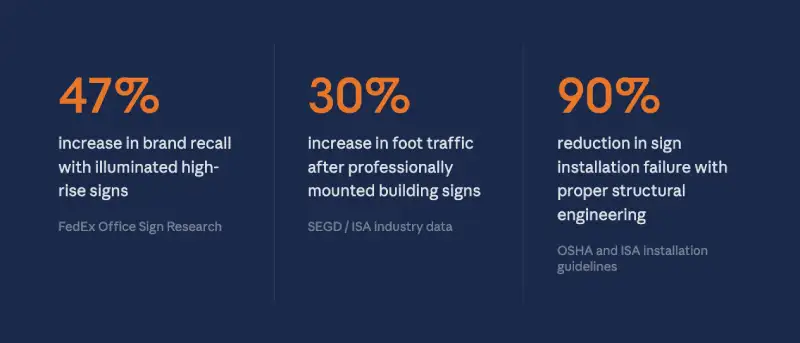
- Structural load analysis becomes mandatory. A sign mounted at elevation carries wind loads that are significantly higher than at grade. Before fabrication begins, a licensed structural engineer calculates the load the building facade can bear, the anchoring method required, and the hardware specifications.
- Denver permitting adds time. The City and County of Denver requires permits for building-mounted signs above certain thresholds. Denver Community Planning and Development reviews signage for zoning compliance, and the process typically adds 2–6 weeks to a project timeline depending on the scope.
- Access requires specialized equipment. Bucket trucks have reach limits. Many high-rise sign installations require crane lifts, swing stage rigging, or rappelling crews. Equipment selection depends on building height, site access, proximity to traffic, and the sign’s weight and dimensions.
- Coordination with building ownership is essential. Most commercial buildings require a certificate of insurance, a scope of work review by the property manager, and often a specific installation window that avoids peak tenant activity.
Understanding these variables upfront is why pre-production planning — not the installation day itself — is where a high-rise sign project succeeds or fails.
The High-Rise Sign Installation Process: Phase by Phase
Every high-rise sign installation we complete in Denver follows the same structured process. Here’s what each phase involves — and what’s happening in the background that clients rarely see.
Phase 1: Site Survey & Structural Assessment
Before any design is finalized, we conduct an on-site survey of the building. This includes measuring the available facade area, documenting the substrate (steel, masonry, EIFS, curtain wall), assessing anchor point locations, and photographing the site from street level and rooftop access points. For buildings above 4 stories, we coordinate a structural engineering review to confirm the facade can accommodate the sign’s dead load and projected wind load at elevation.
Phase 2: Design & Engineering
With site data in hand, our design team finalizes the sign layout, dimensions, and illumination plan. For high-rise installations, we also produce shop drawings and engineering documents — required by the City of Denver for permit review. If the sign is illuminated, electrical drawings are prepared as part of this package. This phase typically runs concurrently with the permit application to save calendar time.
Phase 3: Denver Permitting
We manage the full permit process on behalf of our clients. For high-rise signage in Denver, this typically involves a zoning review through Denver Community Planning and Development, a building permit application with structural calculations attached, and in some cases an electrical permit for illuminated signs. Permitting timelines in Denver currently run 3–5 weeks for standard commercial signage; complex installations or projects in historic overlay districts may take longer. We account for this in every project schedule we propose.
Phase 4: Fabrication
Sign fabrication runs in parallel with permitting. We build every component — cabinet, face, internal LED modules, hardware, and mounting system — to the exact specifications of the engineering drawings. For high-rise installations, tolerances matter more than on ground-level work: a bracket system that’s 1/4-inch off can create alignment issues that are expensive to fix at 200 feet.
Phase 5: Installation
Installation day is the culmination of everything that came before it — and it runs smoothly because of the preparation, not despite it. Depending on the building, we deploy bucket trucks, hydraulic cranes, or rigged swing stage systems. Our installation crew works from a detailed sequence document that covers equipment positioning, anchor installation order, sign lift plan, electrical tie-in, and inspection protocol. We coordinate traffic control, building access windows, and utility clearances before the first vehicle parks on site.
Phase 6: Inspection & Sign-Off
After installation, we conduct a full quality review before requesting final inspection from the City of Denver. This includes verifying anchor torque specifications, checking all electrical connections, reviewing illumination uniformity, and confirming alignment against the approved drawings. We don’t consider a project complete until the city signs off and the client has walked it from street level.
What Sets Our High-Rise Sign Installation Team Apart in Denver
Denver’s commercial sign market has no shortage of vendors. The difference shows up in projects that demand real technical expertise — and high-rise sign installation is the category where that gap is most visible.
We Manage the Whole Project, Not Just the Install Day
Many sign companies separate fabrication, permitting, and installation into three different vendors — leaving clients to coordinate across all of them. Vision Visual Signs handles every phase under one contract. You deal with one point of contact from site survey to final inspection.
We Know Denver’s Permitting Environment
Navigating Denver’s sign permitting process requires familiarity with the city’s zoning overlays, CPD review timelines, and the specific documentation format that reviewers expect. We’ve been through this process for commercial properties across Denver — LoDo, RiNo, Cherry Creek, the Tech Center — and we build accurate permit timelines into every proposal.
Our Installations Are Built for Colorado’s Climate
Denver’s wind, hail, and temperature swings are not afterthoughts in our hardware specs — they’re design inputs. Every high-rise sign we install uses commercial-grade anchoring systems and weather-sealed electrical components rated for Front Range conditions. A sign installed correctly in Denver should perform for 10–15 years without structural issues.
See our work: Visit our outdoor sign projects to review completed installations.
Frequently Asked Questions: High-Rise Sign Installation in Denver
What factors affect high-rise sign installation in Denver?
High-rise sign installation in Denver involves several variables that shape every project: sign size, building height, illumination type, and access equipment requirements. Simpler installations — a single-face channel letter cabinet at 4–6 stories — have very different scope than multi-face rooftop signs with crane lifts and complex electrical work at 10+ stories. Vision Visual Signs provides itemized quotes after a site survey; we don’t provide meaningful estimates without assessing the building.
How long does it take to install a high-rise sign in Denver?
Most high-rise sign installation projects in Denver take 8 to 14 weeks from kickoff to final inspection. This includes 1–2 weeks of site survey and design, 3–5 weeks for Denver permitting, and 2–4 weeks of fabrication running concurrently with permits. Installation day itself is typically 1–3 days depending on complexity. Rush schedules are possible in some circumstances — we’ll advise on this during the proposal phase.
Do you handle Denver building permits for sign installations?
Yes. Vision Visual Signs manages the full permitting process for every commercial sign installation we complete in Denver, including structural calculations, zoning review submissions through Denver Community Planning and Development, and electrical permits for illuminated signs. You don’t need to interface with the city — we handle it as part of the project.
What types of buildings do you install high-rise signs on in Denver?
We install high-rise signage on office towers, mixed-use buildings, hotels, industrial facilities, and multifamily residential buildings throughout Denver and the greater metro area. We work on new construction (where signs are planned during the build) and existing buildings (where we perform a retrofit structural assessment). Our work spans LoDo, RiNo, Denver Tech Center, Englewood, Aurora, Westminster, and surrounding markets.
What’s the difference between a high-rise sign installation and a standard commercial sign installation?
A high-rise sign installation involves additional structural engineering, specialized access equipment (cranes, swing stage rigging, or rappelling crews), and a more involved permit process compared to ground-level commercial signage. The fabrication standards are also higher — hardware must be engineered for elevated wind loads, and installation tolerances are tighter. Vision Visual Signs treats every high-rise project as a full construction project with a dedicated project manager and coordinated subcontractor team.
Ready to get your high-rise sign installed in Denver?
Vision Visual Signs manages every phase — from structural assessment and permitting to fabrication and final inspection. One team, one contract, no gaps.
Request a Quote