Request a Quote

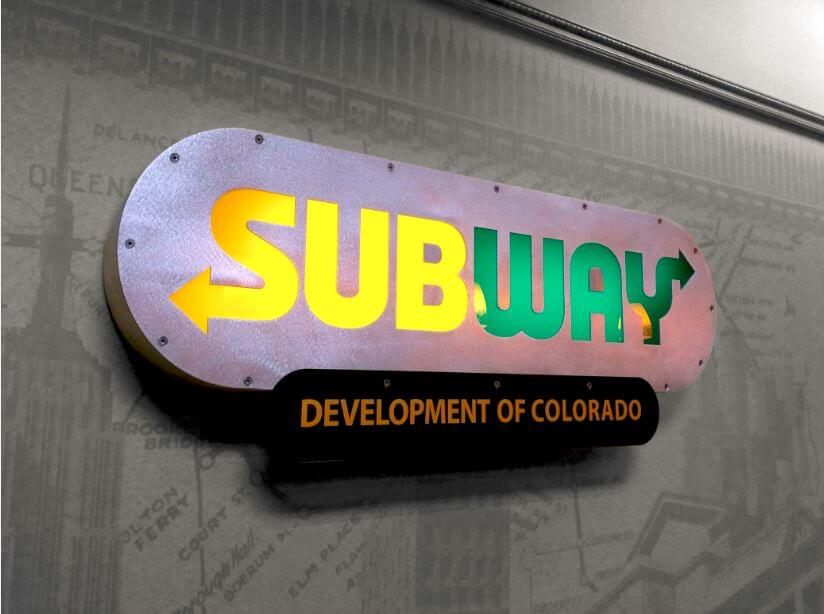
Subway Development Colorado Golden, CO – New Brand Lobby Sign

Dec 15, 2017

Subway LED backlit min

Corporate brand identities change and when they do you may be faced with updating a variety of signs for your business.  Subway updated it’s brand trademark recently and the Development Office in Golden, CO was needing to update the lobby sign in their corporate headquarters.  The unique LED lobby sign cabinet displayed the prior yellow and white trademark using a custom fabricated aluminum faceplate with the trademark cut out and colored acrylic lens in the brand colors.  The management and staff at the office liked the existing design but wanted to update the sign and obtain an exact match for the cabinet finish and style but proudly display the new Subway trademark with the proper corporate brand style guidelines for color and style.  Vision Visual Custom Signs and Graphics Studio was contracted to update the lobby sign and get an exact match for the fit, finishes and style.

Refurbishing an existing sign to get exact finish matches and precisely fabricating components to work with existing parts and assemblies is meticulous work.  Recreation of the part layouts were done by making templates of the existing parts and then creating electronic files that represent the components.  Materials were identified and finishes for each surface were specified to match existing surface textures and finishes.  Precision water jet technology was used to machine the new trademark in 0.10 aluminum sheet stock to obtain a clean and crisp profile.  Vision Visual created new acrylic lens that were color matched to the new brand style guidelines and designed the new parts to fit perfectly in the new sign face.  When all part machining was complete the parts were assembled, and final finishes completed by hand to match perfectly.  The new green and yellow trademark panel was delivered to the headquarters and assembled to the LED fixture with stainless steel hardware.

The headquarters is now proud to display the new brand identity to visitors of their office.  The most important aspect of the project was the exact match between old and new components, which are unnoticeable because of the attention to detail in design and finish work.  When your business is faced with updating brand signage you have options.  In some cases, a complete replacement may make the most sense, but when you want to retain the look of an existing sign structure make sure you contract a company with the right design capabilities and technical capacity to get things fabricated and installed properly.  If your business is planning a brand trademark update call Vision Visual Custom Signs and Graphics for a free project consultation to refresh your interior and exterior building signage and start making a great impression, immediately!

Exit Signs

Exit signs must meet both ADA and International Building Code (IBC) requirements simultaneously. In Denver, this means they must be illuminated or internally lit AND meet tactile/Braille requirements if they are permanently mounted at door level. Overhead exit signs (suspended above 80 inches) are exempt from the tactile requirement but must meet illumination and visibility standards.

Directional and Wayfinding Signs

Directional signs that guide building occupants toward accessible features — accessible entrances, accessible restrooms, elevator banks — must incorporate the appropriate accessibility symbols. Pure wayfinding signs that don’t reference accessible features are generally not required to include Braille or tactile characters, but they must still meet minimum character height and contrast requirements.

If you’re planning a full buildout or renovation and need to understand the complete scope of what’s required, our team can walk you through it. Browse our custom indoor signs to see examples of compliant installations we’ve completed for Denver-area clients.


ADA Signage Requirements at a Glance

The table below summarizes the key ADA requirements for the most common sign types found in Denver commercial buildings. Use it as a quick reference — but note that specific projects may have additional requirements based on occupancy type and local code interpretation.

Sign Type ADA Required? Key Requirement
Permanent Room Signs Yes Braille + raised tactile characters, mounted 60″ centerline from floor
Restroom Signs Yes Grade 2 Braille, ISA symbol required, non-glare finish
Exit Signs Yes (in most cases) Must meet IBC and ADA combined — illumination and tactile requirements
Directional / Wayfinding Partial If directing to accessible features, must include accessibility symbols
Overhead / Suspended Signs Exempt from tactile Overhead signage is exempt from Braille/tactile — but must maintain 80″ min. clearance
Temporary Signs No Temporary signage (less than 7 days) is exempt from ADA tactile requirements

Key ADA Sign Specifications Denver Businesses Need to Know

Mounting Height and Location

ADA requires that tactile room identification signs be mounted so that the centerline of the sign sits at 60 inches above the finished floor. The sign must be installed on the latch side of the door — the side where the handle is — between 18 and 60 inches from the door frame. If there is no room on the latch side due to a wall or architectural feature, the sign should be placed on the nearest adjacent wall.

Tactile Characters and Braille

All required tactile signs must use raised uppercase characters that are between 5/8 inch and 2 inches high, with a minimum 1/32-inch character relief (how much they project from the surface). Below the tactile characters, Grade 2 Braille is required — this is contracted Braille that uses standard abbreviations, not letter-by-letter spelling. Incorrect Braille is one of the most common compliance errors and something a professional fabricator should catch before installation.

Contrast and Finish Requirements

Characters and their background must have a light-on-dark or dark-on-light contrast. ADA does not specify an exact contrast ratio (unlike WCAG for digital content), but most code interpretations require a clearly perceptible difference. Finishes must be non-glare — glossy or highly reflective sign surfaces do not comply, as they reduce legibility for people with low vision.

Font and Character Spacing

ADA requires the use of sans-serif typefaces with uniform stroke widths. Decorative, script, or highly stylized fonts are not compliant. Character spacing must follow specific width-to-height ratios, and word spacing must allow for legible reading. Many businesses purchase visually attractive custom-designed signs that are not ADA-compliant because of typeface choices — this is a preventable mistake.

ADA Sign Installation in Denver: What to Look for in a Sign Company

Large custom indoor wall mural and signage installation by Vision Visual Signs

Not all sign companies are equally equipped to handle ADA compliance. ADA signage involves specific fabrication requirements — the right substrate, correct Braille specifications, proper character relief — that require both the right equipment and experience with the relevant codes.

When evaluating a sign company for your Denver ADA project, look for the following:

  1. Experience with commercial ADA projects — Ask specifically about Denver and Colorado work. A company familiar with local building departments knows how inspections are conducted and what reviewers look for.
  2. In-house fabrication capability — Companies that fabricate their own signs have more control over Braille accuracy, character relief, and finish quality than those who source from third-party suppliers.
  3. Professional installation — Mounting height and door-side placement are critical. Incorrect installation is one of the most common ADA violations — and it’s entirely avoidable with an experienced installer.
  4. Full-project coordination — For larger buildouts or renovations, you need a sign partner who can manage a full sign package across multiple rooms, coordinate with your general contractor, and deliver on a schedule that doesn’t hold up your CO.

Vision Visual Signs has been producing and installing ADA compliant signs for Denver businesses across the metro area, from single-tenant office suites to multi-floor commercial buildings. If you’d like to see examples of our work, visit our ADA indoor signage portfolio.

Frequently Asked Questions: ADA Signs for Denver Businesses

What types of signs must be ADA compliant in Denver?

Any sign that identifies a permanent room or space — including restrooms, conference rooms, stairwells, offices, and exits — must comply with ADA requirements. Directional signs that guide people to accessible features must also use accessibility symbols. Temporary signs and overhead suspended signage are generally exempt from tactile requirements.

What are the ADA mounting height requirements for signs in Colorado?

ADA requires that tactile signs be mounted with the centerline of the sign at 60 inches above the finished floor. Signs must be installed on the latch side of the door (the side the handle is on), between 18 and 60 inches from the door frame. In Colorado, these requirements align directly with federal ADA standards, with no additional state amendments that affect mounting.

Do all Denver businesses need ADA signs?

The ADA applies to all places of public accommodation and commercial facilities. This includes retail stores, offices, restaurants, medical facilities, hotels, banks, and government buildings. Businesses with 15 or more employees that are covered employers are also required to provide accessible workplaces. Essentially, if your Denver business is open to customers or clients, ADA signage compliance applies.

What is the difference between ADA signs and standard signs?

Standard signs are purely visual — they rely on printed text and graphics. ADA-compliant signs include raised tactile characters and Grade 2 Braille so they can be read by touch. They must also use non-glare finishes, meet minimum character height and contrast requirements, and use specific fonts. Not all signs require these features — only those designating permanent rooms and accessible features.

Can existing signs be made ADA compliant, or do they need to be replaced?

In most cases, existing signs need to be replaced rather than modified. ADA requirements are very specific about substrate, character relief, Braille dot specifications, and finish — these cannot typically be added to an existing sign after the fact. When renovating or changing a space, ADA signage updates are typically required as part of the project scope.

Does Vision Visual Signs handle ADA sign installation in Denver?

Yes — Vision Visual Signs provides full ADA signage services in Denver and across the metro area, including design, fabrication, and professional installation. We ensure your signs meet all current ADA and IBC requirements and are correctly positioned per code. Contact us for a consultation on your project.

Learn More About

Vision Visual Custom Sign Company

Serving the Greater Denver and Golden, CO areas. Vision Visual Custom Sign Company specializes in indoor and outdoor signage, sign maintenance and repair. UL electrical sign manufacturer. Project management and permitting. OSHA trained. Contact us today to learn more.