
 (77 Ratings & Reviews)

Commercial signage trends in Denver for 2027 are being shaped less by novelty than by a practical question: will this sign still work in five years? Denver businesses are making sign decisions in a market with fast-changing neighborhoods like RiNo, the Highlands, and Cherry Creek, older brick buildings in LoDo, glass office towers in the Denver Tech Center, and a climate that punishes weak materials. The signage trends below reflect what is driving those decisions, from lighting that fits the building to construction that can be serviced. Each one comes with a note on when it fits and when it does not.
A commercial signage trend is a shift in materials, lighting, or design that changes how businesses specify, build, and maintain signs. The useful ones improve recognition, reduce operating cost, or make a sign easier to service.
Why Denver’s Business Environment Is Accelerating Signage Upgrades
Three local forces are shaping commercial signage trends in Denver, and all three compress sign replacement cycles. New commercial construction and redevelopment keep adding tenants who need signs on buildings with their own design standards. Tenant turnover and rebrands mean signs get replaced because the business changed, not because the sign failed. And Denver’s climate wears signs faster than milder markets, since intense sun at altitude, hail, and wide temperature swings reach faces, seals, and mounting hardware within a few seasons.
That pushes the conversation toward total cost and serviceability. A sign that photographs well on installation day but cannot be repaired without taking it off the wall is a risk, not a bargain.
Trend 1: Signs Designed With the Building
Among 2027 signage trends, the sign that looks bolted onto a facade is losing ground to the sign planned alongside it. Letter depth, mounting distance, raceway concealment, and the color and texture of the wall now get decided together. In Denver the difference shows up between building types. Halo-lit letters can look excellent on smooth, light-colored surfaces but turn patchy on dark, textured brick, where the light has nowhere clean to land. Front-lit letters keep their legibility on those same walls. Glass-and-metal buildings in the Denver Tech Center often suit dimensional or halo-lit logos that echo the architecture.
Ask to see the sign mocked up on a photo of your actual wall, and ask how it looks when switched off, because that is how it appears most of the day. Lit channel letter signs are the usual starting point for this conversation.
Trend 2: Bold Minimalism in Sign Design
This signage trend toward fewer words, stronger wordmarks, and higher contrast keeps gaining ground. Drivers and pedestrians read a sign for a few seconds, and a sign that carries a name, a logo, and one line of copy is read faster than one carrying a paragraph. Denver’s bright light adds a second reason. Thin strokes, low-contrast color pairs, and glossy faces wash out in strong sun, while heavy letterforms and clear contrast hold up.
Many businesses are trading layered logomarks for a single-weight wordmark on exterior signs and keeping the full logo for interior walls and print. Minimal does not mean plain. Every element has to justify its place, and the sign design in Denver process is where those cuts get made, before anything is fabricated.
Trend 3: Mixed Materials, Used With Discipline
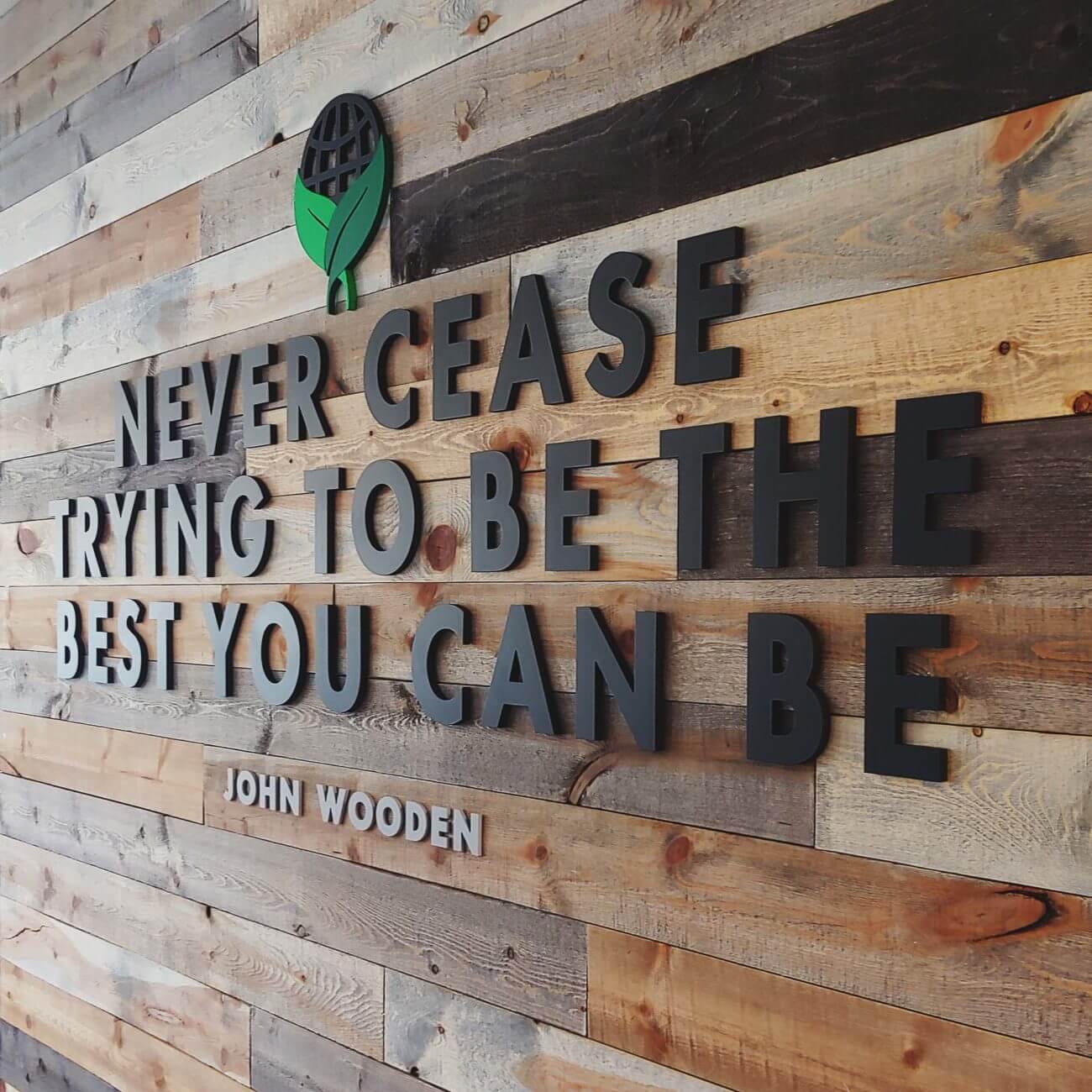
Brushed metal over a dark acrylic backer, painted aluminum with lit edges, raised letters on a textured panel: mixed-material signs add depth in daylight, when most people actually see them. Of all the commercial signage trends on this list, this one is strongest in offices, hospitality, and multi-tenant buildings where each business wants to stand apart without turning up the brightness.
The caution is that materials behave differently outdoors. Metal and acrylic expand at different rates, polished surfaces show scratches and fingerprints, and transparent layers expose fasteners and wiring. Two well-chosen materials usually age better than five. Dimensional brand signs are a common way to carry the same material approach indoors.
Trend 4: LED Replacing Legacy Lighting
Older Denver commercial buildings still carry signs lit by fluorescent tubes and neon, and the retrofit wave is the most measurable of the 2027 signage trends because the economics are straightforward. LED modules draw less power, run cooler, and fail less often, and their failures are easier to fix. Whether an LED retrofit or a new sign makes sense depends on the condition of the cabinet or letters. Sound structures can often be re-lit, while corroded or water-damaged ones cannot.
Energy cost is only part of the case. Utility efficiency programs have at times offered rebates for commercial lighting upgrades, so check current eligibility with your electric utility before buying, since programs change and sign lighting may not qualify. Real neon still has a place where the glow itself is the brand, such as bars and music venues, but for most commercial exteriors LED has become the default.
Trend 5: Wayfinding as Brand Expression
Wayfinding is the signage trend that has moved furthest from afterthought to design priority. It used to be handled with generic arrows. In larger Denver footprints such as office campuses, medical buildings, hotels, and mixed-use developments, it is now designed as a sign family with one type system, one color logic, consistent placement, and destination names that match everywhere a visitor sees them. The payoff is less confusion, fewer calls to reception, and a brand that shows up where visitors are paying attention. Browse the range of indoor signs to see how that looks inside a building.
Accessibility belongs in the first design round, since room identification signs may need tactile characters and Braille depending on the project and jurisdiction. Plan for change as well. Tenants move and departments get renamed, so replaceable inserts cost far less than new signs.
Trend 6: Sustainable, Serviceable Sign Construction
The sixth signage trend, sustainability, mostly comes down to service life and repairability. A sign whose power supply, LED section, or face can be replaced independently stays in service for years. A sealed unit that must be discarded when one part fails becomes waste and a second invoice. Denver owners are right to ask where the power supply is, how the sign opens, and whether the faces can be swapped after a rebrand. Modular faces and accessible back panels let a sign absorb a name change without full replacement.
Maintenance planning belongs in the original specification. Regular inspections catch failing seals and loosening hardware before they turn into a replacement, and sign maintenance and repair costs less when it starts early.
What These Trends Mean for Your Denver Sign Decision in 2027
Not every trend fits every business. Match the trend to the building, the neighborhood, and the stage of the brand. A restaurant on a pedestrian street in LoHi benefits from a projecting blade sign and a warm, readable storefront. A medical office needs calm, high-contrast, accessible signs. An office tenant in a multi-tenant building usually wants a refined dimensional logo that satisfies the landlord’s criteria.
Treat Denver signage trends as a filter, not a shopping list. A reasonable rule is to act now if your sign is failing, outdated, or tied to a rebrand, and to wait if it still performs and your brand is stable. A sign that works is not a trend problem. Whatever you choose, confirm local rules first. Denver regulates sign size, height, lighting, and placement by zone district, and a trend that works in one district may not be allowed in another, so sign permitting in Denver belongs in the plan from day one.
Digital displays deserve a short mention because they dominate many lists of 2027 signage trends. They suit information that changes, such as menus, promotions, and queue status. They do not replace the permanent sign that identifies the business, which keeps working without software, power management, or a network connection. A storefront can run a screen in the window while the channel letters overhead carry identification, and each format does the job it handles well.
Vision Visual’s commercial sign products and services cover the range from lit exteriors to interior brand signs, and browsing outdoor signs in the project gallery shows what these directions look like in completed work.
Frequently Asked Questions
- What is the biggest sign trend for Denver businesses in 2027? – The biggest shift is toward signs designed to fit the building and to be serviced after installation. LED lighting, simpler design, and modular construction all support that goal. Rather than chasing a single effect, Denver businesses are choosing signs that stay legible in strong sun and can be repaired without replacement.
- Are digital displays replacing traditional commercial signs in Denver? – No. Digital displays are growing for frequently changing information, such as menus and promotions, but permanent signs still handle identification and wayfinding. A physical sign works without software, power management, or a network connection. Most businesses do best using each format for the job it handles well.
- How long do commercial signs last before they need to be updated? – Service life depends on the sign type, materials, lighting, and exposure, so no single number fits every sign. Faces and finishes exposed to Denver’s sun usually show wear before the structure does, and lighting technology matters most, since LED systems generally outlast fluorescent and neon tubes. A yearly inspection shows what is aging.
- Does Denver have regulations that affect sign design trends? – Yes. Denver regulates sign size, height, lighting, and placement through its zoning rules, and requirements vary by zone district. Many sign changes need a permit, and leased spaces add landlord criteria on top. Confirm both before fabrication starts.
- How does Colorado’s climate affect sign material choices in 2027? – Colorado’s climate pushes owners toward UV-stable faces, sealed lighting, corrosion-resistant hardware, and structures that tolerate temperature swings. High-altitude sun fades standard vinyl and some plastics, hail damages exposed faces, and thermal cycling loosens fasteners. Ask any contractor which materials are rated for sustained outdoor exposure here.