
 (77 Ratings & Reviews)

Denver’s hospitality sector spans a wide range: national-brand hotels near Denver International Airport and along the downtown convention corridor, boutique properties in RiNo and LoDo, independent restaurants across Cherry Creek, LoHi, and Berkeley, and the growing food hall and mixed-use hospitality developments that have reshaped whole neighborhoods over the last decade.
Every one of these properties uses signage as part of the guest experience. Signage draws people in from the street. It guides them through the property. It communicates brand identity at scale. It makes first and last impressions that guests remember and review. This guide covers what hospitality signage does and how Denver hotel and restaurant operators approach it.
Why Hospitality Signage Is Its Own Discipline
Hospitality signage serves a wider range of purposes than most commercial signage. Exterior identification, brand expression, guest wayfinding, room and facility identification, event and function communication, retail promotion within the property (spa, restaurant, bar), and outdoor amenity signage (pool, fitness center, valet) all sit within a single coordinated system in a hospitality property. Each function has different requirements, and a well-designed hospitality sign system serves all of them without compromise.
The operational context is different too. Hospitality signage operates in an environment where guest experience is the product: a poorly designed sign is not just a functional inefficiency but an experience problem that shows up in reviews and shapes property reputation. A hotel that has invested in every guest-facing detail except signage tells guests something specific about the property’s standards through the omission.
The 24-hour operating context matters as well. Hotels and hospitality venues receive guests around the clock, which means exterior identification, wayfinding to arrival areas, and safety-critical signage all need to function through the full daily cycle. Non-illuminated signage that reads well at noon and disappears at 10 PM fails the guest arriving late from an airport transfer.
Exterior Signage for Denver Hotels
The exterior sign system for a hotel typically covers primary identification, entry approach, and 24/7 visibility considerations.
Primary Identification: Building-Mounted Signs and Monument Signs
The primary brand identifier is typically a building-mounted illuminated sign at the top of the building or on a prominent facade, complemented by a monument sign at the property entry for arriving guests and driver visibility. For hotels near highways with fast-moving traffic (Denver International Airport corridor, I-25 and I-70 interchange properties), pylon signs provide the visibility needed for highway sightlines that a lower-profile monument sign cannot match.
Franchise properties operate within brand standards developed by the hotel corporate office; the sign design conversation happens within those parameters. Boutique properties have more design freedom and can develop signage that expresses the specific character of the property.
Porte-Cochère and Entry Signage
The porte-cochère (the covered entry canopy at the valet drop-off) is where arriving guests transition from vehicle to lobby. Signage in this zone reinforces the brand at the first personal interaction point of the guest experience. Illuminated signage integrated into the porte-cochère structure, directional signs for valet, self-park, and luggage service, and the property’s primary logo identification at the entry drive all contribute to the arrival experience.
Illuminated Signs for 24/7 Guest Arrival
Hotels receive guests around the clock. Every element of exterior identification and entry wayfinding must be visible and functional 24/7. LED illumination is the standard for all exterior hotel signage, and the brightness and color temperature choices affect the mood the property projects at night. A cool white color temperature reads more clinical; a warmer white reads more welcoming. These are choices worth making deliberately rather than defaulting to the manufacturer’s standard output.
Restaurant Signs: Exterior Impact and Interior Personality
Denver’s restaurant corridors are dense with dining options. A restaurant’s exterior sign is often the primary tool for capturing walk-in traffic against direct competition on the same block. We’ve covered sign design for Denver restaurants in a dedicated post; the summary is that illuminated channel letters, projecting signs (blade signs perpendicular to the building), and creative dimensional installations all appear in Denver’s restaurant districts.
Neon and neon-look LED signs remain culturally strong for restaurants, since they signal food service, evening operation, and a specific aesthetic vocabulary that customers respond to. Modern LED technology can produce neon-look output without the maintenance and fragility of traditional gas neon, but authentic gas neon still has its place for restaurants where the material specifically fits the concept.
Interior signage extends the restaurant’s brand story inside the space. Hostess station identification, restroom identification, menu boards, and cocktail special signs are all opportunities to reinforce the concept. Denver restaurant design uses a wide vocabulary of interior signage, including chalk-style signage on painted chalkboard, dimensional letters on wood backers, and backlit acrylic elements. The coordinated design across exterior and interior signs creates the sense of a unified concept rather than a collection of disconnected elements.
Hotel Wayfinding: Making Multi-Story Properties Navigable
Wayfinding is a critical hospitality function that touches nearly every guest interaction with the property. Elevator lobby floor identifiers tell guests they are on the right floor. Room number sequences guide them to their specific room. Wing identification helps in larger properties where the same floor number continues across multiple wings. Amenity direction supports guest use of the property’s facilities. Meeting room and function space identification serves the group business that many Denver hotels rely on.
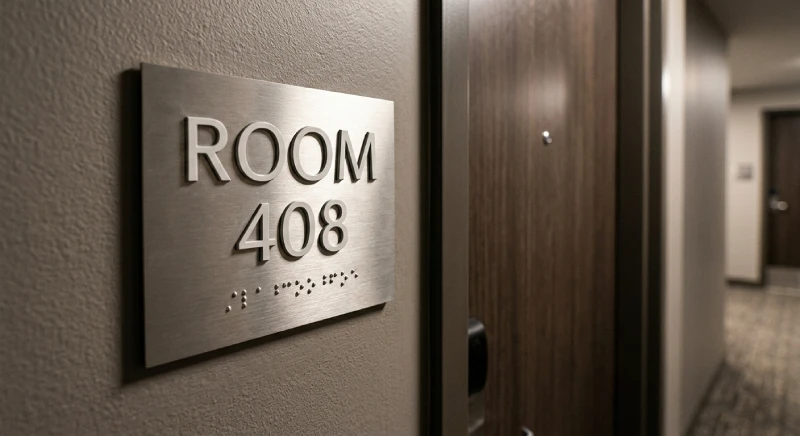
ADA compliance requires tactile characters and Grade 2 Braille on permanent room identification signs, including guest room signs. This is a legal requirement for publicly accessible hotels, and quality hotel signage programs meet it as a standard part of the design rather than as an afterthought.
Consistency of design language across all wayfinding elements matters as much as the individual signs. A hotel where the room signs use one design vocabulary and the amenity signs use another feels less considered than one where everything reads as a coordinated system. This coordination is easier to achieve when the full wayfinding program is designed together at the outset than when signs are added incrementally over time by different providers.
Meeting Room and Event Signage for Denver Convention Hotels
Denver hosts a significant convention business: the Colorado Convention Center anchors a substantial hospitality economy, and the major downtown hotels serve the group and event market as a core revenue category. Convention hotels need signage systems that can be updated for each event without full replacement. This overlaps significantly with the practices used in office building directory sign systems, since replaceable modular panels rather than static engraved signs.
Digital directory signs that display current events, changeable message boards for meeting room identification, and printed foamboard or vinyl-on-Coroplast event signage produced on short lead times all support this operational reality. Meeting room name insert panels that swap for each event allow the same permanent sign framework to identify different events across days or weeks. The scale of a national convention week at a major Denver hotel requires an efficient event-signage workflow that a sign company with hospitality experience can execute.
Working with a Sign Company on Denver Hospitality Projects
Hospitality operators need specific capabilities from a sign partner and an understanding of hospitality brand standards for franchise properties: franchise hotels have specific brand books that govern sign design, and a sign company unfamiliar with brand standards will propose designs that get rejected by corporate approval. Ability to produce complex sign systems with consistent quality across many components. A hotel signage program typically involves dozens or hundreds of individual signs, and consistency in quality across all of them matters.
Installation coordination that accommodates hotel operations is essential. Hotels cannot close for sign installation. Installations happen after hours, on occupied floors, without disrupting guest experience. A sign company that has done hospitality work understands this operational constraint and plans installations accordingly.
Ability to produce short-lead-time event signage in support of the event calendar rounds out the capability set for convention properties. A sign company that can turn around meeting room panels, event directional signs, and function identification within days is a working partner for hotels with active group business; a sign company that requires two weeks lead time for any print job cannot support that business.
FAQ
- What signage does a Denver hotel need? – A standard Denver hotel signage program includes exterior brand identification (building-mounted or monument sign), porte-cochère entry signage, exterior wayfinding for parking and valet, interior lobby and reception signage, elevator lobby floor identifiers, ADA-compliant room number signs, amenity direction (pool, fitness center, business center), and function/meeting room identification for properties with event facilities. Convention hotels also need event signage systems that can be updated for each event.
- What are the sign requirements for hotels in Denver? – Denver hotels must comply with the City and County of Denver zoning code sign regulations, ADA Standards for Accessible Design for interior signage (tactile characters and Braille on permanent room signs), and any applicable brand standards for franchise properties. Signs are subject to sign permit requirements for permanent exterior signs. Hotels in specific overlay districts (downtown Denver, historic districts) may have additional design guidelines applicable to sign type and materials.
- How does hospitality signage differ from standard commercial signage? – Hospitality signage serves the guest experience as a primary function, not just wayfinding and identification. This means design tone, material quality, illumination quality, and coordination across the property’s signage system matter more than in most commercial contexts. Guests notice sign quality as part of the property’s overall polish, and a well-designed sign system contributes to positive guest reviews in a way that standard commercial signage does not.
- What sign types work best for Denver restaurants? – Denver restaurants use a wide range of sign types depending on the concept and location. Illuminated channel letters or projecting signs work well for street-facing restaurants attracting walk-in traffic. Neon and neon-look LED signs remain culturally strong for restaurants. Dimensional letters on wood or metal backers suit rustic and casual concepts. Interior signage extends the brand story. The right sign type depends on the restaurant’s concept, location, and target audience.
- How often do hotel signs need to be updated or replaced? – Exterior hotel signage typically has a service life of eight to fifteen years before repainting, refacing, or replacement is warranted. Interior wayfinding signs last similarly long. Event and function signage is designed for shorter-term use, since insert panels for meeting rooms are updated weekly for convention hotels. Brand refresh cycles for franchise hotels happen every seven to ten years on average.