
 (77 Ratings & Reviews)
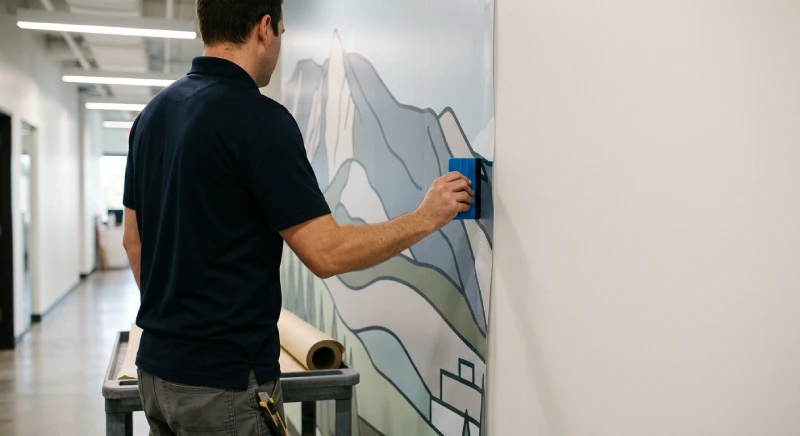
Denver’s office market has shifted noticeably in the last five years. The RiNo, LoDo, and Cherry Creek submarkets have seen a wave of tenant improvements as companies reshape their spaces to draw employees back to the office and to reflect brand identities that have often evolved faster than the physical environments where the work happens. Wall murals and large-format graphics are central to that reshaping. They transform blank drywall into brand statements without the cost or timeline of a full renovation, and they photograph well for the recruiting and social media content that offices increasingly need to generate.
This guide covers what Denver office managers, business owners, and interior designers need to know about wall murals: the categories, the materials, the practical installation considerations, and how to plan a project that works for the space and lasts through the length of a typical office lease.
Why Denver Offices Are Investing in Wall Murals and Graphics
The business context has changed. Return-to-office decisions have made office atmosphere a factor in employee attendance and satisfaction; a company asking employees to spend three or four days a week in the office is competing against home offices that people have optimized for their own comfort. The physical workplace needs to earn the commute. Aesthetically thoughtful spaces do this better than functional-only spaces. For tech companies specifically, a well-designed lobby sign and reception environment pairs naturally with wall murals as complementary parts of the same brand statement.
Recruiting content increasingly features the physical workplace. Companies in Denver tech, finance, and professional services routinely include office photography in their careers pages, employer branding content, and social media. A branded office with intentional wall graphics, murals, and environmental design photographs differently than a generic office with white walls, and the difference shows up in what candidates see when they research a potential employer.
The financial comparison is favorable. A full interior renovation of a Denver office runs $80 to $150 per square foot and takes weeks. Wall murals and environmental graphics deliver most of the visual transformation of a renovation at a fraction of the cost, in a fraction of the time, without the disruption of demolition and construction. For businesses in mid-lease that want to refresh the space without renegotiating the tenant improvement allowance, wall graphics are the practical answer.
Types of Wall Murals and Office Graphics
The wall graphics category covers several distinct formats, each with its own applications, budget range, and installation characteristics.
Full-Wall Photographic and Illustrated Murals
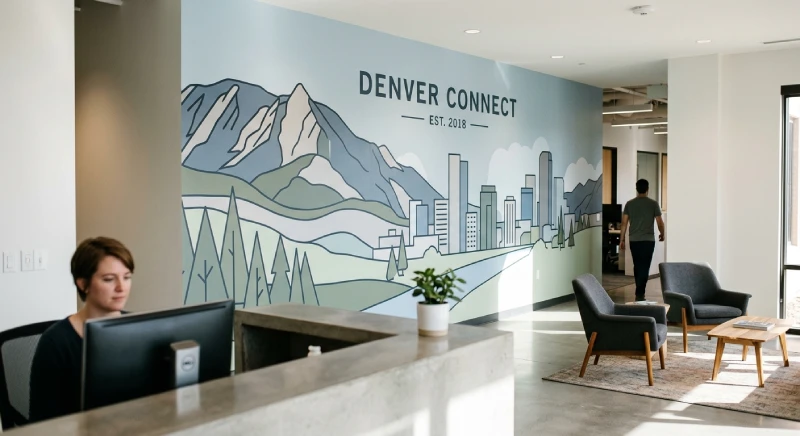
Full-wall murals are the most visually transformative wall graphic category. They cover entire wall surfaces with photographic imagery, custom illustration, or graphic patterns. Common in reception areas, collaboration zones, and feature walls in break rooms and conference rooms, these installations turn a wall into a defining feature of the space. Fabric SEG (silicone edge graphic) systems produce a premium tensioned finish with the graphic replaceable when messaging changes. Direct-applied vinyl is the more cost-effective installation and works well on smooth painted drywall.
Brand Walls: Logos, Values, and Mission Statements
Brand walls emphasize typography and identity rather than photographic imagery. A large-scale company logo, a mission statement in feature typography, or company values presented as an installation are the standard formats. These are commonly placed in reception areas, primary meeting rooms, or the wall behind the main office entry, which are the surfaces visitors and employees see first. Dimensional cut vinyl, applied acrylic letters, or backlit metal for premium executions produce results that read as intentional brand statements rather than decoration.
Wayfinding and Environmental Graphics
Some wall graphics serve dual purposes: aesthetic and functional. Floor identifiers at elevator lobbies, department markers, colored corridor bands that support navigation while adding visual interest, and directional graphics at decision points in larger offices all fall into this category. Well-designed environmental graphics reinforce brand identity while making the office easier to navigate.
Materials and Installation: What Denver Office Managers Should Know
The technical considerations for wall mural installation come down to substrate, adhesive, and environmental conditions.
Wall substrate matters. Smooth painted drywall is the ideal surface for vinyl wall murals: the vinyl adheres cleanly, the graphic reads as flat, and removal at end of lease is straightforward. Lightly textured walls (light orange peel) accept vinyl with the understanding that some texture may show through. Heavily textured walls require skim-coating to a smooth finish before mural application. Brick, concrete, and other porous surfaces need alternative solutions, often a fabric SEG mounting system rather than direct-applied vinyl.
Wall preparation is critical for adhesion. New paint should be fully cured (typically 30 days or more) before vinyl is applied. Recently painted walls with uncured paint can cause vinyl to lift or adhere unevenly. Walls should be clean, dry, and free of dust before installation. A quality installer confirms wall condition and addresses any issues before starting the graphic application.
Vinyl selection affects both aesthetics and longevity. Cast vinyl (the same category used for vehicle wraps) is the premium option, the most conforming, the longest-lasting, and the cleanest to remove. Calendered vinyl is less expensive and is appropriate for shorter-term installations or applications where premium performance is not required. Specialty vinyls (dry-erase, magnetic-receptive, chalkboard) support functional wall applications that combine branding with usable surface.
Colorado altitude and typical office HVAC create dry indoor air conditions that can affect vinyl performance over time. Very dry office air can affect adhesion at edges on some vinyl products over extended service. Quality cast vinyl products from established manufacturers handle these conditions well, but the choice of product matters; economy vinyls that perform acceptably in humid climates may show edge lifting more quickly in dry Denver conditions.
Design Considerations for Office Wall Murals
The design of an office wall mural is what separates an installation that anchors the space from one that looks like an afterthought. A sign company’s creative team can help develop concepts that work at the scale of the wall and integrate with the office’s existing palette. Several principles apply consistently.
Scale relative to the wall matters. A mural sized correctly for the wall dominates the space in the way a mural should. A mural sized too small floats in the middle of a larger wall and looks tentative. When in doubt, err larger: an installation that fills the wall with intentional margins reads as designed; one that leaves too much bare wall around it reads as an incomplete project.
The choice among photography, illustration, and typography sets the mood of the space. Photographic murals bring specific places or people into the office and set an emotional tone through the imagery choice. Illustrated murals allow more brand-controlled aesthetics and can incorporate abstract or interpretive elements. Typographic installations communicate directly through language and are appropriate when the message is the point.
Color relationship to the existing office palette matters. A mural that clashes with the office’s wall paint, flooring, or furniture creates visual tension. A mural that is designed to complement the existing palette reinforces the overall aesthetic. This is one reason that visual branding and logo development work often precedes or accompanies wall mural design: the brand system provides the color and typographic vocabulary the mural then extends into the physical space.
Longevity of the concept is worth considering. A mural that references a specific current initiative may look dated 18 months later when the initiative has moved on. Murals that reference enduring brand values, company mission, or the character of the space itself age better than those tied to time-limited campaigns.
From Concept to Installation: The Office Wall Mural Process
A typical office wall mural project follows a predictable sequence. It starts with a site visit: the sign company visits the office to assess wall surfaces, measure dimensions, and understand the space context. This is when the scope gets defined, and the design conversation begins.
Design development follows. For clients with in-house creative resources, the sign company works from client-supplied artwork. For clients without in-house design, the sign company’s creative team develops the mural concept and produces proofs. Color matching against existing brand standards is confirmed at this stage.
Proof review is the point at which the design is finalized. Reviewing the proof carefully prevents errors that would require reprinting after installation. Written approval of the final proof formalizes the design.
Production and installation follow proof approval. Vinyl production is typically completed within a few business days. Installation of most wall murals is scheduled around office operations and takes a few hours for standard scopes. A typical Denver office wall mural project runs three to five weeks from initial consultation to installed graphic. You can start the process by requesting a quote with your wall dimensions and a rough design brief.
FAQ
- How long does a wall mural last in an office environment? – A quality vinyl wall mural in a normal office environment typically lasts eight to twelve years before the material begins to show wear or aesthetic dating. Fabric SEG wall systems with replaceable graphic panels last indefinitely on the frame side, with the printed graphic replaceable when messaging or design changes. High-contact areas may show wear earlier than non-contact surfaces.
- Can wall murals be removed without damaging office walls? – Yes. Professionally applied vinyl murals are designed for clean removal when the time comes. Using heat and correct removal technique, quality vinyl releases from painted drywall surfaces without paint damage in most cases. The variables are wall paint type, paint cure time when the vinyl was applied, and how long the graphic has been installed. For leased Denver office spaces, the removability of vinyl murals compared to permanent finishes is a significant practical advantage at end of lease.
- How much do office wall murals cost in Denver? – Office wall mural costs vary significantly by size, material, and design complexity. Direct-applied vinyl murals typically range from $8 to $18 per square foot for standard designs; fabric SEG systems with frames range higher due to the hardware component. A typical 8-foot by 12-foot vinyl reception mural costs approximately $800 to $1,600 depending on materials and finish. A detailed quote requires a site visit and understanding of the design scope.
- What wall surfaces work best for murals? – Smooth painted drywall is the ideal surface for vinyl wall murals. Lightly textured walls (light orange peel) accept vinyl acceptably with the understanding that some texture will show through the graphic. Heavily textured walls (knockdown, skip trowel) should be skim-coated to a smooth finish before mural application. Brick, concrete, and other porous surfaces need appropriate preparation or a fabric SEG mounting system rather than direct-applied vinyl.
- How long does wall mural installation take? – Wall mural installation time depends on size and complexity. A standard 8-foot by 12-foot vinyl mural can typically be installed in three to five hours. Larger installations, full-wall murals, and multi-panel installations can take a full day or two days for very large scopes. Installations in occupied offices are typically scheduled after hours or on weekends to avoid disrupting operations.